
Woodstock Hospital is Using Blood Wisely
See how Woodstock Hospital earned national recognition for improving transfusion practices through the Using Blood Wisely program.
Woodstock Hospital is Using Blood Wisely
See how Woodstock Hospital earned national recognition for improving transfusion practices through the Using Blood Wisely program.
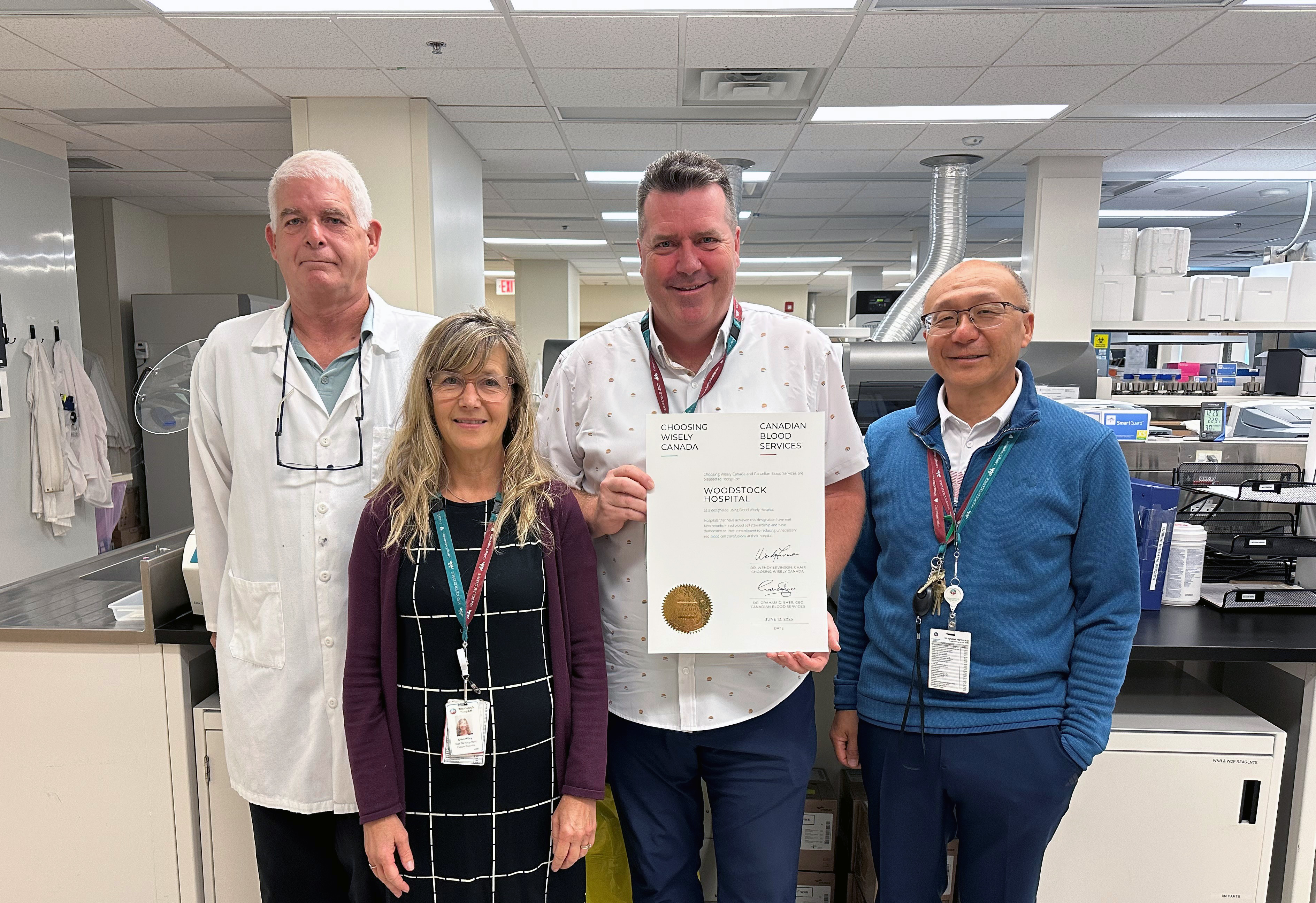
In 2025, Woodstock Hospital reached a major milestone by earning its Using Blood Wisely Hospital designation. David Rupert, Director of Technical Services and Cardiorespiratory, shares that this achievement reflects strong collaboration across departments and the team’s continued pursuit of improvement.
Blood is one of the most vital health care resources, yet studies show up to 30% of transfusions in Canadian hospitals may not be necessary. At Woodstock Hospital in Ontario, leadership has long recognized the importance of responsible blood management. That commitment led the hospital to join the Using Blood Wisely program in 2020 to meet national transfusion appropriateness benchmarks.
Early efforts and planning at Woodstock focused on reviewing blood product usage, updating transfusion order sets and guidelines, and staff education. “It was great to see the high level of collaboration,” says David. “Leadership, laboratory, nursing, staff, and physicians all working together to achieve this goal.”
The COVID-19 pandemic temporarily paused efforts in 2020, but the hospital resumed in 2022 with renewed focus. Education was prioritized as a key intervention to drive change. Physician rounds, led by Dr. Dorien Ruijs from the Ontario Regional Blood Coordinating Network (ORBCoN), helped reinforce best practices. The team also shared ORBCoN’s Bloody Easy modules with physicians and nurses, offering evidence-based education on appropriate transfusion practices.
Data also served as an important tool to meet the program’s benchmarks. Jay Cronkwright, Charge Medical Laboratory Technologist, worked with the data analytics department to create more robust data sets tracking hemoglobin results, transfusion locations, and ordering providers. Monthly audits and performance feedback was shared with the hospital’s Blood Management Committee, Hospital Quality Committee, and Hospital Quality Council. This regular reporting created transparency in transfusion ordering and opportunities to adjust efforts as needed.
The results of these interventions have led to measurable benefits. The hospital has successfully reduced unnecessary transfusions and improved the appropriateness of orders.
“This designation demonstrates to our organization and community that we are dedicated to ensuring this valuable resource is used appropriately and effectively,” he says.
The Using Blood Wisely program has provided a strong framework for quality improvement. Woodstock Hospital’s experience shows how structured, collaborative approaches can drive change, enhance patient care, and inspire future improvement efforts. The hospital will continue to build on these efforts by sustaining benchmarks to maintain their designation.